显示标签为“CAS: 1135-40-6”的博文。显示所有博文

2020年5月9日星期六

What are the production methods of N-Cyclohexyl-3-aminopropanesulfonic acid (CAPS)

N-Cyclohexyl-3-aminopropanesulfonic acid (caps), is a biological buffer, mainly used in biochemical diagnostic kits, DNA / RNA extraction kits and PCR diagnostic kits. The preparation process of caps has been receiving attention. This article will introduce three production methods of caps.
The first method:Dissolve cyclohexylamine in ethanol, then slowly add propionolactone, control the reaction temperature at about 50 ℃ through the feeding speed; after adding, continue the heat preservation reaction for 4 hours, filter and dry the caps crude. Then dissolve the crude 3- (cyclohexylamine) propanesulfonic acid (caps) in 100g of hot water and add ethanol, cool and crystallize, filter and dry to obtain the finished product of 3- (cyclohexylamine) propanesulfonic acid (caps).
This method has a simple process but the product solution of the produced caps has poor absorbance and has a problem of suspended matter, which results in low yield and poor quality during production.
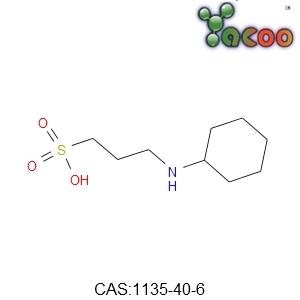
CAS: 1135-40-6
The second method:Dissolve propionolactone in N, N-dimethylformamide according to the weight ratio; add cyclohexylamine according to the preset speed, and control the reaction temperature at 30 ℃ through the preset speed of feeding; continue the heat preservation reaction for n hours after feeding, and then filter and dry to obtain crude caps product; dissolve the caps in hot water, then add ethanol, and then cool to 0 ℃, and then dry to obtain finished product of caps.
There are similarities in the preparation process of these two methods, the latter is an improvement of the former, and the yield of the resulting product is high and the quality is good.
The third method:Dissolve 1,3-propane sultone with organic solvent A to obtain organic solution containing 1,3-propane sultone, dissolve cyclohexylamine with organic solvent B to obtain organic solution containing cyclohexylamine; The organic solution of propane sultone and the organic solution containing cyclohexylamine are simultaneously pumped into the micro-channel reactor to react to obtain the reaction liquid; then the obtained reaction liquid is precipitated by freezing crystallization of the crude caps and then passed through nitrogen pressure filtration to obtain the finished caps product .
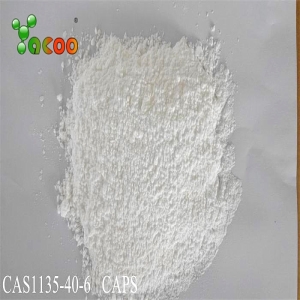
98% CAPS
The operation process of this method is simple and stable and controllable, and the production capacity and product yield are improved.
In summary, the preparation of caps mainly uses propane sultone and cyclohexylamine as raw materials. Through continuous development, standards such as simple process, high yield and good quality are the pursuit of caps production, which is conducive to high quality and high purity caps Production will help to further expand the application of caps.

2018年11月19日星期一

The incompleted transfer of protein in WB? CAPS may help you!


We always encountered various problems in Western Blot (WB):
  • Incomplete transfer of protein?
  • High background?
  • No positive bands?
......
Below we will give corresponding solutions to the possible reasons for the problem of insufficient transfer of protein, and hope it can help you succeed in the experiment.


1. Why does the transfer of protein is needed?

Western Blot is a method in which proteins are transferred to a membrane and then detected using an antibody. For known expression proteins, the corresponding antibody can be used as a primary antibody for detection, and the expression product of the new gene can be detected by the fusion portion of the antibody.

The protein sample separated by PAGE is transferred to a solid phase carrier (for example, a nitrocellulose membrane), and the solid phase carrier adsorbs the protein with a non-covalent bond, and can maintain the type of polypeptide and its biological activity. The protein or polypeptide on the solid phase carrier is used as an antigen, and the corresponding antibody is immunoreactive, and then reacted with the enzyme or the isotope-labeled secondary antibody, and the protein expressed by specific gene is detected by substrate color development or autoradiography.

2. The reason and solution of the incompleted transferance

Reasons
Solutions
The film is not completely soaked
Use 100% methanol permeable membrane
molecular weight of Target protein is less than 10,000
Select a small pore size membrane to shorten the transfer time
The isoelectric point of the target protein is equal to or close to the pH of the transfer buffer
Try using other buffers such as N-Cyclohexyl-3-Aminopropanesulfonic Acid (CAPS) buffer (pH 10.5) or using low pH buffers such as acetate buffer
Methanol concentration is too high
Excessive methanol concentration causes the protein to separate from the SDS, thereby precipitating in the gel, while causing the gel to shrink or harden, thereby inhibiting the transfer of high molecular weight proteins. Reduce methanol concentration or use ethanol or isopropanol instead
Insufficient transfer time
Extended transfer time for thick gels and high molecular weight proteins

3. Preparation method for CAPS (CAS 1135-40-6) buffer

Please see the following table (Both concentrations of buffer and sodium hydroxide are 0.1 mol/L):

pH of CAPS Buffer
Volume (CAPS)
Volume (NaOH)
6.8
250
0
10.0
218.3
31.7
10.5
178.6
71.4
10.8
156.3
93.7
11.2
138.9
111.1
The specific operation of the preparation is: 0.1 mol/L CAPS buffer solution is first prepared in a volumetric flask. During the configuration process, the buffer has to be dehydrated at a high temperature and cooled in a desiccator; 0.1 mol/L sodium hydroxide solution is also formulated at the same time. According to the formula in the above table, a buffer solution corresponding to pH can be prepared, and sodium hydroxide is mainly used to adjust the pH.

Western blotting can be applied to detect target proteins from protein mixtures, quantitatively or qualitatively determine the expression of proteins in cells or tissues, and subsequent analysis of protein-protein, protein-DNA, and protein-RNA interactions. Film transfer is the basis of WB, and its quality is the key to the success of WB. We hope that the above methods can help you succeed in the process of transfor.