2020年5月19日星期二

Application of poly aluminium chloride in sewage treatment of sand washing plant

The common sand washing field, in the process of sand washing, the wastewater has a large amount of water and is difficult to deposit quickly. Generally has two above deposition pool to filter out larger suspension or particles, However, most of the sediment needs to be added pac poly aluminum chloride and poly acrylamide for flocculation and deposition to reach the clear pool, shorten the time of sewage treatment and reduce the suspended matter content in the mud wastewater of the sand washing site, which can be useful for recycling and improve the recycling efficiency of circulating water.The method is as follows:

1.An aqueous solution with a concentration of 0.2% was prepared.
2.Due to the wide range of water PH values applicable to this product, the general dosage is 0.1-10ppm (0.1-10mg/L).
3.Dissolve well. When it is required to dissolve, the water body should be fully stirred up before slowly and evenly taking part in the dose.
4.The stirring speed is generally 400 RPM, and the time is not less than 60 minutes.
Marketing Center: RM 603, RuiYing Building, Nanhai District, Foshan, Guangdong, China
Factory : Area A No.9, Technology Park, Sanshui District, Foshan, Guangdong, China
Tel : +86 13929123248
Email : exp@broviecn.com
Fax : 0086-757-85510580
Website : www.bv-alu.com

2020年5月10日星期日

Sodium Hydroxide Is One Of The Raw Materials Of Handmade Soap

As is well-known, sodium hydroxide is strong alkaline which is harmful to the skin. But when saponified with oil and water, it is no longer sodium hydroxide, but soap and glycerin. The production of the handmade soap in life also needs sodium hydroxide. Many people may ask if handmade soap use sodium hydroxide, why it still call pure natural product? Is it safe to use? The following I will give you a brief introduction of the process of handmade soap production. Saponification is the reaction that the strong alkaline and ester react and generate alcohols and carboxylate. In the narrow sense, saponification is limited to the combination of grease and strong alkaline (sodium hydroxide and potassium hydroxide), resulting in the higher fatty acid sodium salt and glycerin, which is a step in the process of making soap, hence the name is from it. The saponification equation is as follows:
Sodium Hydroxide Is One Of The Raw Materials Of Handmade Soap
CH2OCO-R
|
CHOCO-R     + 3NaOH → 3R-COONa + CH2OH-CHOH-CH2OH
|
CH2OCO-R
Can saponification reaction have residual sodium hydroxide? To make sure there’s no residual sodium hydroxide, the handmade soap must place 1 to 2 months after reaction. And even if there’s a little of free sodium hydroxide after the reaction, after a period of time, it can be reduced to alkalescence. So the soap of complete saponification won’t hurt the skin. The final product of saponification is fat, sodium acid and glycerin in theory, the glycerin of saponification is retained. It is the important substance of skin moisture, which is also one of the reasons why handmade soap is called pure natural soap.
Sodium Hydroxide Is One Of The Raw Materials Of Handmade Soap
Why do we feel dry when we wash our face with the soap from the supermarket? Most industrial soaps will extract glycerine, which is used to make other skin care products or industrial supplies. The soap is without the natural skin-care ingredient glycerin, and contains many artificial additives that can cause discomfort.
Marketing Center: Room 603, RuiYing Building, Chengnan 1st Road, Dali Town, Nanhai District, Foshan City, Guangdong Province,China, 528231
Factory: Area A No.9, Technology Park, Sanshui District, Foshan, Guangdong, China
Tel : +86 13929123248
Email : exp006@broviecn.com
Fax : 0086-0757-85510580

How To Make Polyacrylamide Work Best

The three important indexes of polyacrylamide are molecular weight, hydrolysis degree, and solid content. There are three main indicators of cationic polyacrylamide: ionicity, solid content and molecular weight. The molecular weight of anion polyacrylamide is from 6 million to 22 million, and the cationic polyacrylamide ionicity is from 20 percent to 60 percent. Recently, a number of customers in different fields have reported that adding polyacrylamide is not very effective. Water purification materials for rivers suggest that corresponding anion or cationic products should be selected according to on-site sewage treatment process and equipment.
Then, why the effluent treatment of polyacrylamide PAM fails to achieve the effect mentioned by the manufacturer? The reasons are analyzed along with the source water purification material:
1. Dissolution time: after polyacrylamide dissolves into liquid, it should be used as soon as possible. With the increase of storage time, the agent will degrade with time, and the lower the liquid viscosity, the more influence the sewage treatment effect will be. In general, polyacrylamide liquids can be stored for about 1-2 days. And the solid polyacrylamide storage time is longer, in general, customers are recommended to use polyacrylamide water solution now.
Ratio of 2, temperature influence: polyacrylamide liquid, the temperature reaches 60 ℃ began to slow degradation, 22 million molecular weight of anionic flocculant in high temperature reaches a certain degradation to around $5 million, or even destroy the molecular chain structure, effect use effect with the increase of temperature, the degradation of faster and faster.
Marketing Center: Room 603, RuiYing Building, Chengnan 1st Road, Dali Town, Nanhai District, Foshan City, Guangdong Province,China, 528231
Factory: Area A No.9, Technology Park, Sanshui District, Foshan, Guangdong, China
Tel : +86 13929123248
Email : exp006@broviecn.com
Fax : 0086-0757-85510580

The Caking Reasons Of Caustic Soda Flakes

When using caustic soda, the user found that there are problems with caking that affect normal use, but it was not clear what caused this. Two possible causes of caustic soda clotting are summarized below.
1.Temperature of caustic Soda
The temperature of caustic soda is determined by the flow rate of cooling water and the rotating speed of machine. The amount of circulating water, the temperature circulating water, Whether the sprinkler is blocked and scale formation in the rotary drum of a caustic soda machine directly affect the temperature of caustic soda and the uniformity of the charging temperature of a caustic soda machine. After cleaning the sprinkler head,cleaning the scale formation,  increasing circulating water, decreasing the temperature of caustic soda flakes from 65℃ to 58℃, the caking phenomenon can be alleviated.

2.Caustic soda caking due to moisture Absorption
The laminar bag is a double-layer packing bag. If the seam is not fast enough or the seam is not tight enough, the laminar in the bag is easy to absorb moisture and affect its quality. So the original single seam was changed into a double seam, and the packaging personnel were required to inspect the processes of entrainment and suture, so as to achieve large air isolation and greatly reduce the problem of caking caused by loose sealing.
There is no direct relation between the quality and the caustic soda caking. However, if the caking happens, it will affect the normal use and the effect of use. Therefore, the manufacturer should pay special attention to the production and the use of users.
Marketing Center: Room 603, RuiYing Building, Chengnan 1st Road, Dali Town, Nanhai District, Foshan City, Guangdong Province,China, 528231
Factory: Area A No.9, Technology Park, Sanshui District, Foshan, Guangdong, China
Tel : +86 13929123248
Email : exp006@broviecn.com
Fax : 0086-0757-85510580

2020年5月9日星期六

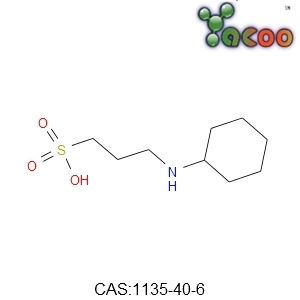
What are the production methods of N-Cyclohexyl-3-aminopropanesulfonic acid (CAPS)

N-Cyclohexyl-3-aminopropanesulfonic acid (caps), is a biological buffer, mainly used in biochemical diagnostic kits, DNA / RNA extraction kits and PCR diagnostic kits. The preparation process of caps has been receiving attention. This article will introduce three production methods of caps.
The first method:Dissolve cyclohexylamine in ethanol, then slowly add propionolactone, control the reaction temperature at about 50 ℃ through the feeding speed; after adding, continue the heat preservation reaction for 4 hours, filter and dry the caps crude. Then dissolve the crude 3- (cyclohexylamine) propanesulfonic acid (caps) in 100g of hot water and add ethanol, cool and crystallize, filter and dry to obtain the finished product of 3- (cyclohexylamine) propanesulfonic acid (caps).
This method has a simple process but the product solution of the produced caps has poor absorbance and has a problem of suspended matter, which results in low yield and poor quality during production.
CAS: 1135-40-6
The second method:Dissolve propionolactone in N, N-dimethylformamide according to the weight ratio; add cyclohexylamine according to the preset speed, and control the reaction temperature at 30 ℃ through the preset speed of feeding; continue the heat preservation reaction for n hours after feeding, and then filter and dry to obtain crude caps product; dissolve the caps in hot water, then add ethanol, and then cool to 0 ℃, and then dry to obtain finished product of caps.
There are similarities in the preparation process of these two methods, the latter is an improvement of the former, and the yield of the resulting product is high and the quality is good.
The third method:Dissolve 1,3-propane sultone with organic solvent A to obtain organic solution containing 1,3-propane sultone, dissolve cyclohexylamine with organic solvent B to obtain organic solution containing cyclohexylamine; The organic solution of propane sultone and the organic solution containing cyclohexylamine are simultaneously pumped into the micro-channel reactor to react to obtain the reaction liquid; then the obtained reaction liquid is precipitated by freezing crystallization of the crude caps and then passed through nitrogen pressure filtration to obtain the finished caps product .
98% CAPS
The operation process of this method is simple and stable and controllable, and the production capacity and product yield are improved.
In summary, the preparation of caps mainly uses propane sultone and cyclohexylamine as raw materials. Through continuous development, standards such as simple process, high yield and good quality are the pursuit of caps production, which is conducive to high quality and high purity caps Production will help to further expand the application of caps.

The Main Preparation Method Of Tris (2-Carboxyethyl) Phosphine Hydrochloride(TCEP-HCI)

Tris(2-carbonylethyl)phosphoric acid hydrochloride (TCEP-HCI) is a novel reducing agent and deprotecting agent for thiolated DNA. Tris(2-carbonylethyl)phosphoric acid hydrochloride (TCEP HCI) is more stable and more compatible than the conventional reducing agent and deprotecting agent mercaptoethanol or dithiothreitol (DTT). TCEP-HCI is recognized as an ideal reducing agent without any irritating odor .
At present, there are mainly the following methods for the synthesis route of tris(2-carbonylethyl)phosphoric acid hydrochloride (TCEP -HCI):
The first method: Reacting phosphine with phosphine PH 3 as a raw material in an autoclave, followed by hydrolysis to obtain tris(2-carbonylethyl)phosphoric acid hydrochloride (TCEP-HCI). Although this method has a high yield, the autoclave and the highly toxic gas phosphine need to be used in the reaction process, and the risk factor is high, which is not conducive to industrial production.
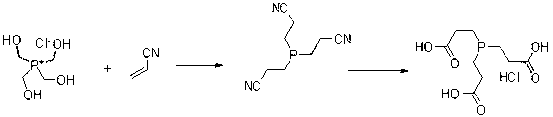
The second method: Using tetramethylolphosphonium chloride as a raw material to react with acrylonitrile. Finally, it was hydrolyzed with concentrated hydrochloric acid to give the product. The steps of this method are simple, but it uses tetramethylolphosphonium chloride to replace the highly toxic gas phosphine to synthesize tricyanoethylphosphine, but tris-cyanoethyl phosphate is hydrolyzed to give tris(2-carbonylethyl)phosphoric acid hydrochloride (TCEP). A solid mixture of hydrochloride and ammonium chloride, the two salts of the mixture can not achieve effective separation, the product purity is low.

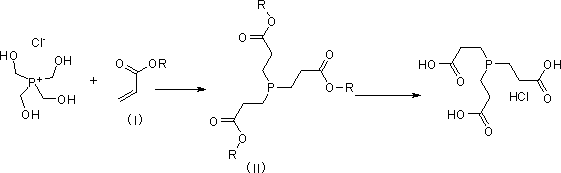
The third method: talkylation reaction of tetramethylolphosphorus chloride and the compound in an organic solvent in the presence of a base yields trimethyl 3, 3 ', 3' '-phosphine triyl tripropionate, Then hydrolysis reaction occurs in concentrated hydrochloric acid to obtain the compound TCEP-HCl. This method is easy to operate, has low cost and high yield, and is suitable for industrial production.


Related links:High Purity TCEP-HCI

2020年5月7日星期四

petrochemical industrial applications of N-methyl pyrrolidone

With the development of chemical technology and industrial modernization, the quality requirements for lubricants have gradually increased. Lubricant base oils contain a large number of polycyclic aromatic hydrocarbons, alkanes, and highly polar substances that affect their viscosity and oxidation. The traditional refining method uses phenol and furfural as raw materials to extract its aromatics, but due to its poor solubility and insufficient refining depth, it is gradually replaced by the NMP refining process. As early as the mid 1970s, due to its outstanding advantages, foreign countries attach great importance to the development of N-methyl pyrrolidone refining processes and realize the industrialization of NMP refining processes. Krishna et al. [5] of the Indian Institute of Petroleum, respectively, adopted NMP refining methods and furfural refining The method was used to experimentally study the spindle oil fractions of Oman crude oil.

The results showed that NMP Solvent outperformed furfural in terms of refining yield, oxidation resistance, and oil-to-mass ratio. Subsequently, the NMP refining process developed rapidly abroad. By the early 1990s, the N-Methyl-2-Pyrrolidone refining process had exceeded one and a half in the United States. At the same time, China ’s NMP plant gradually replaced furfural refining equipment, and some companies are also retrofitting phenol and furfural units. When the refined oil meets the same quality requirements, the NMP refining process not only reduces the upper temperature and the volume ratio of the agent to the oil, but also improves the lubricating oil yield. The scientific research results show that compared with furfural, it has stable chemical properties and high yields of essential oils, and is an excellent extraction solvent for refined high viscosity lubricants. It was confirmed that too high water content and temperature are not conducive to the refining of distillate oils. Only a proper increase in temperature can improve the quality of lubricating base oils. At the same time, it shows that the use of NMP refined lubricants has good development prospects and practical value. Due to the corrosion problems of some parts and equipment of NMP refining equipment, Sinopec Lanzhou General Plant has carried out research on corrosion causes and protective measures from various aspects such as technology and equipment. At the same time, it draws on the anti-corrosion experience of similar equipment in foreign countries to make process improvements and Equipment modification, adopting measures such as 254S M steel with higher key content and nitrogen sealing, basically solved the corrosion problem of the device, reduced the loss of the device, met the requirements of environmental protection, extended the operating cycle of the device, The rapid improvement has accumulated valuable experience. Compared with phenol and furfural, NMP has the characteristics of strong dissolving power, low energy consumption, low extraction temperature, high refining yield, etc., compared with phenol and furfural Solvent.